Rapid extraction of high-purity RNA in just 30 minutes. Safe and non-toxic, free from phenol, chloroform, and other organic reagents.
Cat. No. :
Y1011R01-50TBrand :
YanbiotechProduct Origin :
ChinaVolume :
50TProduct Information:
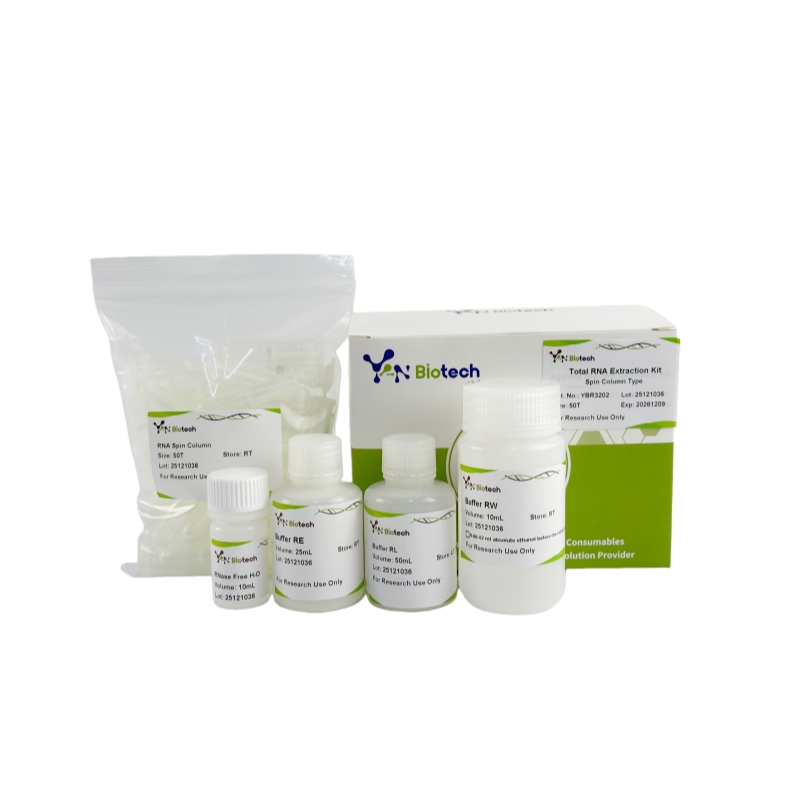
This kit is a broad-spectrum product designed for the purification of total RNA from animal tissues and cultured cells using a spin column-based method. It employs a unique lysis buffer system that eliminates the need for organic solvents such as phenol and chloroform. The procedure utilizes a gDNA Eraser Spin Column (for genomic DNA removal) and an RNA Spin Column (for RNA binding) to rapidly isolate high-purity RNA from 5-20 mg of animal tissue or 1×10⁵ to 1×10⁷ freshly cultured cells. The entire extraction process can be completed in as little as 30 minutes. The purified RNA is suitable for direct use in various molecular biology applications, including Northern blotting, dot blot hybridization, mRNA purification, in vitro translation, RNase protection assays, RT-PCR, Real-Time RT-PCR, and cDNA library construction
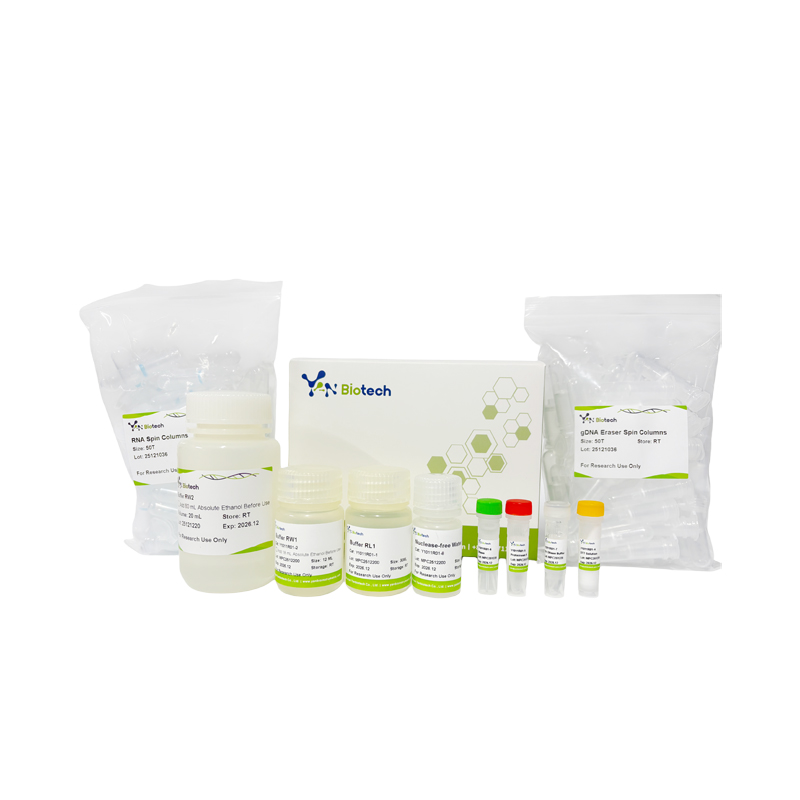
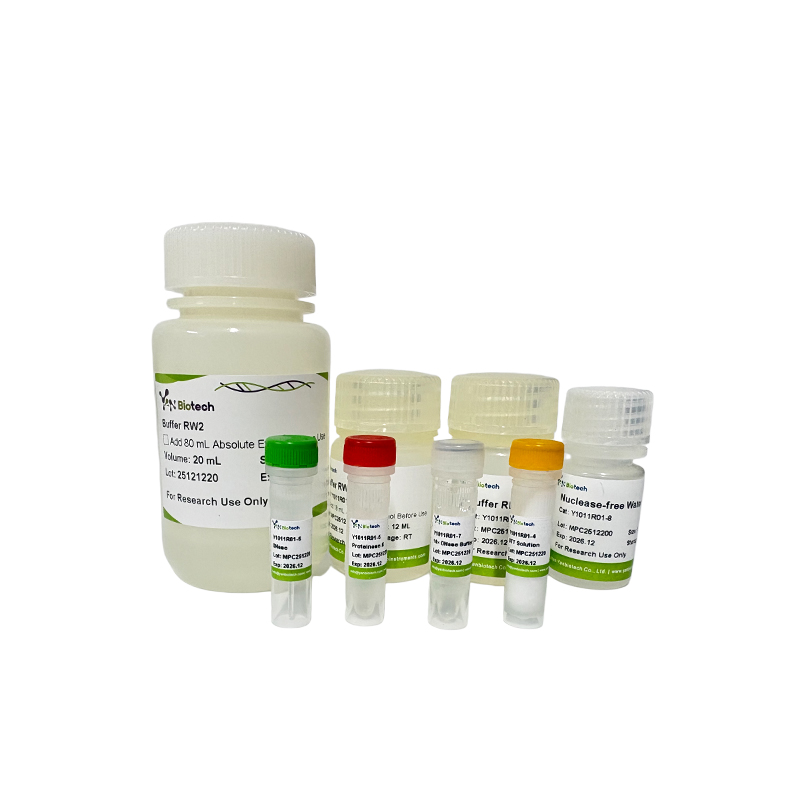
| Contents | Storage | 50T |
| Buffer RL1 | RT | 30mL |
| Buffer RW1 | RT | 12 mL (Add 18 mL absolute ethanol according to the instructions before first use) |
| Buffer RW2 | RT | 20 mL (Add 80 mL absolute ethanol according to the instructions before first use) |
| DTT Solution | RT | 2×0.8 mL |
| Proteinase K | -20℃ | 500 μL |
| DNase | RT | 250 μL |
| 10×DNase Buffer | RT | 500 μL |
| Nuclease-free Water | RT | 12 mL |
| gDNA Eraser Spin Columns | RT | 50 pcs |
| RNA Spin Columns | RT | 50pcs |
Storage Conditions:
Proteinase K, DNase, and DTT Solution are shipped on wet ice and should be stored at -20°C. All other reagents are shipped and stored at room temperature. The shelf life is 12 months.
Instructions for Use:
1. Sample Lysis:
a. Animal Tissue: Take 5-20 mg of animal tissue (fresh, cryopreserved, or preserved in Tissue RNA Stabilization Solution (G3019 recommended)). Place it into a 1.5 mL nuclease-free centrifuge tube or a specialized grinding tube pre-filled with 2-3 grinding beads (3 mm, G0203-150G recommended) and 500 μL of Buffer RL1 (ensure DTT Solution has been added before use). Use a tissue homogenizer (YB-H3D recommended) to thoroughly grind the tissue into a homogenate at low temperature (incomplete homogenization will affect RNA yield and quality). Then, add 10 μL of Proteinase K, mix well, incubate at 56°C for 10-15 min, and centrifuge at 12,000 rpm for 5 min at 4°C.
b. Animal Tissue: Take 5-20 mg of animal tissue (fresh, cryopreserved, or preserved in Tissue RNA Stabilization Solution (G3019 recommended)). Place it into a 1.5 mL nuclease-free centrifuge tube or a specialized grinding tube pre-filled with 500 μL of Buffer RL1 (ensure DTT Solution has been added before use). Place the tube on ice and use an electric grinder to thoroughly homogenize the tissue (incomplete homogenization will affect RNA yield and quality). Then, add 10 μL of Proteinase K, mix well, incubate at 56°C for 10-15 min, and centrifuge at 12,000 rpm for 5 min at 4°C.
c. Animal Tissue: Take 5-20 mg of animal tissue (fresh, cryopreserved, or preserved in Tissue RNA Stabilization Solution (G3019 recommended)). Quickly transfer it to a mortar pre-cooled with liquid nitrogen. Grind the tissue with a pestle, continuously adding liquid nitrogen, until it becomes a fine powder (incomplete pulverization will affect RNA yield and quality). Transfer the powdered sample to a 1.5 mL nuclease-free centrifuge tube containing 500 μL of Buffer RL1 (ensure DTT Solution has been added before use). Mix thoroughly by pipetting. Then, add 10 μL of Proteinase K, mix well, incubate at 56°C for 10-15 min, and centrifuge at 12,000 rpm for 5 min at 4°C.
d. Suspension Culture Cells: Transfer the suspension cells along with the culture medium into a 1.5 mL nuclease-free centrifuge tube. Centrifuge at 1,000 rpm for 5 min to pellet the cells. Carefully aspirate and discard the supernatant. Add the recommended volume of Buffer RL1 (see Table 1) to the cell pellet (ensure DTT Solution has been added before use). Pipette repeatedly until no visible cell clumps remain. Then, add 10 μL of Proteinase K, mix well, incubate at 56°C for 10-15 min, and centrifuge at 12,000 rpm for 5 min at 4°C.
e. Adherent Culture Cells: Remove the culture medium and wash the cells once with 1×PBS (pH 7.4). Add the recommended volume of Buffer RL1 (see Table 1) to the culture dish (ensure DTT Solution has been added before use). Gently pipette to detach the cells completely. Transfer the lysate containing the cells to a 1.5 mL nuclease-free centrifuge tube. Then, add 10 μL of Proteinase K, mix well, incubate at 56°C for 15 min, and centrifuge at 12,000 rpm for 5 min at 4°C.
2. Transfer the supernatant from the animal tissue or cell lysate obtained in step 1 to a gDNA Eraser Spin Column (avoid pipetting any precipitate). Centrifuge at 12,000 rpm for 1 min at room temperature.
3. Discard the gDNA Eraser Spin Column. Save the filtrate in the Collection Tube.
4. Add an equal volume of 60% isopropanol to the filtrate from the previous step (precipitation may occur at this point). Mix thoroughly by pipetting.
5. Transfer the entire mixture (including any precipitate) to an RNA Spin Column. Do not exceed 600 µL per addition. If the volume exceeds 600 µL, add it in batches.
6. Centrifuge at 12,000 rpm for 30 s at room temperature. Discard the flow-through and place the RNA Spin Column back into the Collection Tube.
7. Add 500 µL of Buffer RW1 to the RNA Spin Column. Centrifuge at 12,000 rpm for 30 s at room temperature. Discard the flow-through.
8. Add 600 µL of Buffer RW2 to the RNA Spin Column (pipet the Buffer RW2 along the wall of the spin column to help wash away residual salts). Centrifuge at 12,000 rpm for 30 s at room temperature. Discard the flow-through.
9. DNase Digestion (Optional): The reagents provided in this kit and the gDNA Eraser Spin Column effectively remove most genomic DNA, so the purified RNA rarely contains genomic DNA contamination. For tissues with high genomic DNA content (e.g., liver, kidney, spleen) or for downstream applications requiring exceptionally pure RNA, optional on-column DNase digestion can be performed:
a. Preparation of DNase Reaction Mix: In a new 1.5 mL nuclease-free centrifuge tube, mix 5 µL of 10× DNase Buffer, 5 µL of DNase, and 40 µL of Nuclease-free Water.
b. Add 50 µL of the DNase Reaction Mix to the center of the RNA Spin Column membrane. Incubate at room temperature for 15 min.
c. Add 500 µL of Buffer RW2 to the RNA Spin Column. Centrifuge at 12,000 rpm for 30 s at room temperature. Discard the flow-through and place the column back into the collection tube.
10. Repeat step 8.
11. Place the RNA Spin Column back into the Collection Tube. Centrifuge at 12,000 rpm for 2 min at room temperature to remove any residual liquid.
12. Transfer the RNA Spin Column to a new 1.5 mL nuclease-free centrifuge tube. Open the lid and let it stand at room temperature for 3-5 min to allow complete evaporation of residual ethanol from the column.
13. Add 50-100 µL of Nuclease-free Water to the center of the membrane of the RNA Spin Column. Let it stand at room temperature for 5 min. Centrifuge at 12,000 rpm for 2 min at at room temperature to elute the RNA. To obtain a higher concentration of RNA, the eluate can be re-applied to the center of the RNA Spin Column membrane, incubatedfor another 5 min at room temperature, and centrifuged again at 12,000 rpm for 2 min at room temperature to collect the RNA.
Notice:
1. When using, thaw and mix thoroughly, thaw and store at 4℃, avoid freeze - thaw cycles.
2. Change the electrophoresis buffer and use freshly prepared agarose gel in time to avoid affecting the electrophoresis results.
3. For your safty and health,please wear safety glasses, gloves, or protective clothing.
4. For Reseacrch Use Only
Stay Connected With Us



Copyright @ Wuhan Yanbiotech Co., Ltd. All Rights Reserved.
 Network Supported Xml / Privacy Policy
 English
 English
 Русский
 Español