HighPure Plasmid Extraction Mini Kit (Spin Column) Free Endotoxin for Life Science Research
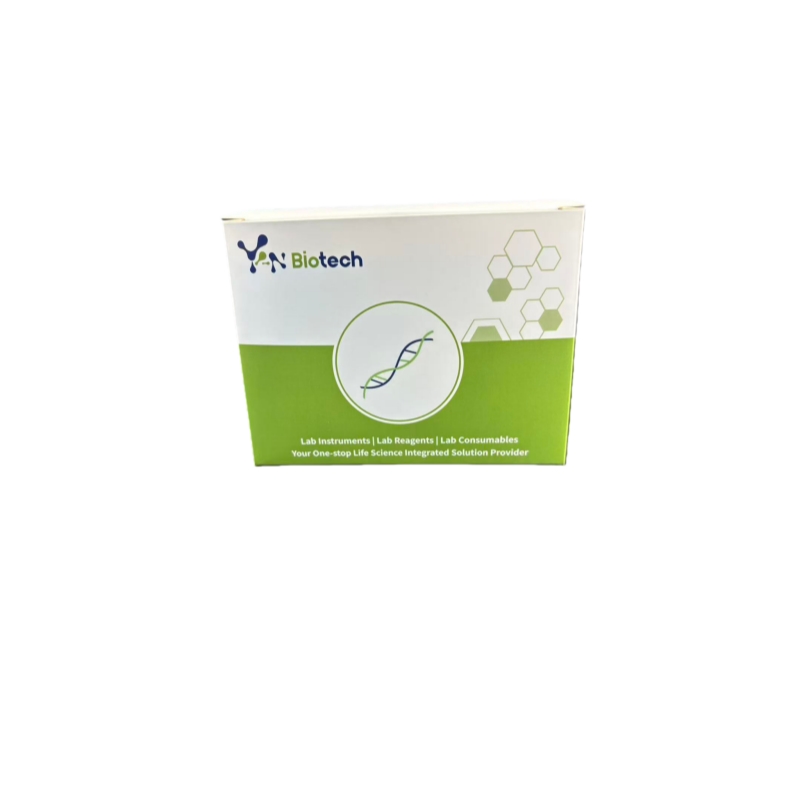
For rapid extraction of 10-20 µg of pure, high-copy plasmid DNA from 1.5-4.5 mL of E.coli LB culture
Cat. No. :
YBD3301-50TBrand :
YanbiotechProduct Origin :
ChinaVolume :
50TSpec. :
Spin Column TypeI. Product Introduction
YBP3301-50T, HighPure Plasmid Extraction Mini Kit uses an improved SDS-alkaline lysis method to lyse cells. The silica membrane in the spin column selectively binds plasmid DNA from the solution under high-salt, low-pH conditions. Impurities and other bacterial components are then removed using the Deproteinization Buffer and Wash Buffer. Finally, pure plasmid DNA is eluted from the silica membrane with the low-salt, high-pH Elution Buffer.
II. Product Information:
Contents |
Storage |
YBP3301-50T | YBP3301-100T | YBP3301-200T |
| 50T | 100T | 200T | ||
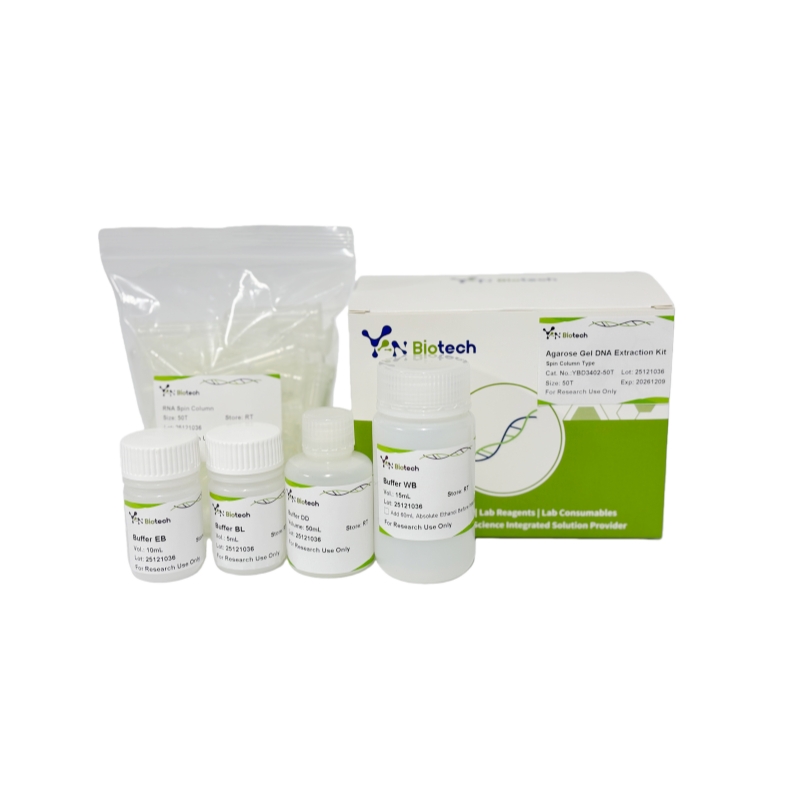
| Balanc Buffer BL | RT | 5 mL | 10 mL | 2×10 mL |
| Rnase A(10mg/mL) | -20℃ | 150 µL | 250 µL | 500 µL |
| Buffer P1 | 4 ℃ | 15 mL | 25 mL | 50 mL |
| Buffer P2 | RT | 15 mL | 25 mL | 50 mL |
| Buffer P3 | RT | 20 mL | 35 mL | 70 mL |
| Deproteinization Buffer PE | RT | 16mL | 32 mL | 2×32 mL |
| Add specified amount of ethanol according to the instructions before use | ||||
| Wash Buffer WB | RT | 13 mL | 25 mL | 2×25 mL |
| Add specified amount of ethanol according to the instructions before use | ||||
| Elution Buffer EB | RT | 15 mL | 15 mL | 20 mL |
| Spin Column Spin AC | RT | 50 pcs | 2×50 pcs | 4×50 pcs |
| Collection Tube (2mL) | RT | 50 pcs | 2×50 pcs | 4×50 pcs |
III. Storage Condition:
1.This kit can be stored for 12 months under dry conditions at room temperature (15°C-25°C). The endotoxin removal agent can be transported at ambient temperature, stored at 4°C for one month, and stored long-term at -20°C.
2.Upon first use, add the entire contents of the supplied RNase A vial to Solution P1 (final concentration 100 µg/mL) and store at 2-8°C thereafter. If the RNase A in Solution P1 becomes inactive, the extracted plasmid may contain trace amounts of RNA; simply supplement Solution P1 with fresh RNase A.
3.SDS in Solution P2 may precipitate or become cloudy at low temperatures. Heat in a 37°C water bath for several minutes to restore clarity. Avoid vigorous shaking to prevent excessive foaming.
4.To prevent evaporation, oxidation, and pH changes, close bottle caps tightly immediately after each use.
IV. Product Feature:
1.The silica membrane in the spin columns is made of high-quality, specially formulated adsorption material, ensuring minimal variation in binding capacity between columns.
2.The unique Deproteinization Buffer formula efficiently removes residual nucleases, even from nuclease-rich bacterial strains such as the JM series and HB101, effectively preventing plasmid degradation.
3. Fast and convenient. No need for toxic reagents like phenol or chloroform, nor ethanol precipitation. Yields high quantities of pure plasmid DNA suitable for direct use in various molecular biology applications such as restriction digestion, transformation, PCR, in vitro transcription, and sequencing.
V. Application:
For rapid extraction of 10-20 µg of pure, high-copy plasmid DNA from 1.5-4.5 mL of E. coli LB culture.
VI. Procedure (Please read the precautions before starting the experiment):
1.Pellet bacteria from 1.5-4.5 mL of overnight culture by centrifuging at 12,000 rpm for 30 seconds. Decant the supernatant completely. To collect more than 1.5 mL of culture, repeat centrifugation and supernatant removal in the same 1.5 mL tube until sufficient bacterial pellet is obtained.
2.Resuspend the bacterial pellet thoroughly in 250 µL of Solution P1 by vortexing.。
Incomplete resuspension will affect lysis, reducing yield and purity.
3.Add 250 µL of Solution P2. Mix gently by inverting the tube 6-8 times to lyse the cells completely. Incubate at room temperature for 4 minutes.
Mix gently; do not vortex, to avoid shearing genomic DNA! Do not exceed 5 minutes, as this may damage plasmids. The lysate should become clear and viscous. If using a small amount of bacteria, proceed to the next step once clear and viscous; the full 5 minutes is not mandatory.
4.Add 350 µL of Solution P3. Immediately mix gently by inverting 6-8 times. A white flocculent precipitate will form. Centrifuge at 13,000 rpm for 10 minutes. Carefully transfer the supernatant.
Mix immediately after adding Solution P3 to avoid local precipitation of SDS.
Pretreat a spin column with Balance Buffer.
This is a mandatory step. Refer to the procedure in section VI.7.2 ("Regarding the Use of Balance Buffer").
5.Apply the supernatant from step 4 to a pretreated Spin Column AC (placed in a collection tube). Centrifuge at 12,000 rpm for 30-60 seconds. Discard the flow-through.
6.Optional Step - Deproteinization: Add 500 µL of Deproteinization Buffer PE (ensure ethanol has been added). Centrifuge at 12,000 rpm for 30-60 seconds. Discard the flow-through.
This step removes trace impurities like nucleases. **It is recommended for nuclease-rich strains (e.g., JM series, HB101, wild-type, endA+ strains). It can be omitted for common endA- strains with low nuclease content (e.g., XL-1 Blue, Top10, DH5α).
7.Add 600 µL of Wash Buffer WB (check that ethanol has been added!). Centrifuge at 12,000 rpm for 30 seconds. Discard the flow-through.
8.Repeat Step 7 with another 600 µL of Wash Buffer WB.
9.Place the Spin Column AC back into the empty collection tube. Centrifuge at 13,000 rpm for 2 minutes to dry the membrane completely and remove residual ethanol, which can inhibit downstream reactions.
10.Transfer the Spin Column AC to a clean microcentrifuge tube. Apply 50-100 µL of Elution Buffer EB (pre-warmed to 65-70°C for better results) directly onto the center of the membrane. Let stand at room temperature for 2 minutes. Centrifuge at 12,000 rpm for 1 minute.
For higher yield: Reload the eluate onto the same column and centrifuge for 1 minute.
Larger elution volumes increase elution efficiency. For higher plasmid concentration, the volume can be reduced, but should not be less than 30 µL, as very small volumes reduce elution efficiency and yield.

Stay Connected With Us



Copyright @ Wuhan Yanbiotech Co., Ltd. All Rights Reserved.
 Network Supported Xml / Privacy Policy
 English
 English
 Русский
 Español